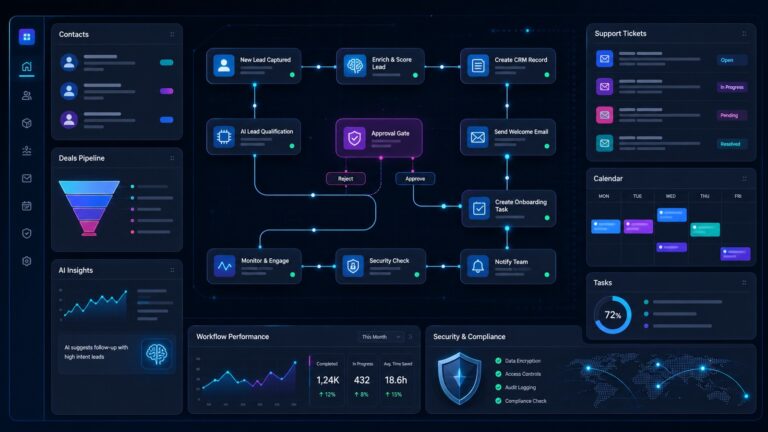
Quick take: July’s AI security news is not just about model prompts or chatbot policies. The new signal small businesses should pay attention to is operational: AI workflow tools, collaboration platforms, remote support software, WordPress page builders, and network appliances are all showing up in the same patch-priority conversation. The practical lesson is simple: treat AI automation like privileged software, and treat CISA’s Known Exploited Vulnerabilities catalog as a weekly action list rather than a reference document you read once.

The July 2026 update to the CISA Known Exploited Vulnerabilities catalog included a mix that matters for small teams: a Langflow authorization-bypass vulnerability, Microsoft SharePoint deserialization risk, Adobe ColdFusion path traversal, SimpleHelp authentication bypass, multiple UniFi OS issues, and page-builder vulnerabilities affecting WordPress-style publishing stacks. That mix should get attention because it cuts across the exact stack many lean companies rely on: AI tooling, internal documents, support access, web publishing, and network administration.
This is not a reason to panic or rip out every AI tool. It is a reason to stop treating AI pilots as “experiments” that live outside normal security governance. If a workflow builder can touch customer data, support tickets, documents, API keys, browser sessions, or internal automations, it belongs in your asset inventory and patch process.
Why this July AI security update matters
For the last year, many small businesses have focused AI security on employee behavior: don’t paste secrets into chatbots, don’t trust every AI answer, and don’t let generated code ship without review. Those rules still matter. But the newer risk is more architectural. AI tools are increasingly connected to calendars, CRMs, help desks, file storage, browsers, databases, and automation platforms. A vulnerability in an AI workflow environment is therefore not just “an AI bug.” It can become an access-control problem, a data-flow problem, and a lateral-movement problem.
CISA’s July 7 catalog release listed CVE-2026-55255, described as a Langflow authorization bypass through a user-controlled key. Langflow is commonly associated with building and orchestrating AI workflows. The important business takeaway is broader than one product: any internal AI workflow builder should be reviewed as a high-value application, especially if it connects to production services or stores credentials.
The same catalog update also included vulnerabilities in SharePoint, ColdFusion, remote support tooling, UniFi OS, Cisco Unified Communications Manager, and web page builders. That pattern shows why small teams need a cross-functional patch rhythm. The “AI security” meeting cannot be separate from the “web server,” “IT support,” and “SaaS admin” conversations. Attackers do not respect org-chart boundaries.
What changed in CISA KEV this week
At the time of writing, CISA’s Known Exploited Vulnerabilities catalog version was listed as 2026.07.07, released on July 7, 2026. Several recently added items stand out for small and mid-sized organizations:
| Risk area | Recent KEV signal | Small-business action |
|---|---|---|
| AI workflow automation | Langflow authorization-bypass entry added July 7 | Inventory AI workflow tools, check exposure, rotate secrets if compromise is suspected, and patch quickly. |
| Collaboration and intranet content | Microsoft SharePoint Server deserialization risk added July 1 | Prioritize internet-facing or externally reachable collaboration systems before less exposed apps. |
| Remote support | SimpleHelp authentication-bypass entry added June 29 | Audit remote support software because it often has administrator-level reach across endpoints. |
| Network and edge administration | UniFi OS entries added June 23 | Review exposed admin panels, firmware levels, MFA, and segmented management networks. |
| Publishing stack | JoomShaper and Joomlack page-builder entries added July 7 | Do not ignore CMS plugins and builders; disable unused components and patch web publishing tools fast. |
CISA’s remediation deadlines are designed for covered federal civilian agencies, but private businesses can still use the dates as an urgency signal. If a vulnerability is in KEV, the issue has evidence of known exploitation. For a small business, that should usually outrank a theoretical medium-severity issue in software that is not exposed and does not hold sensitive data.
The AI-specific lesson: workflow tools need least privilege
The biggest mistake small teams make with AI workflow platforms is granting broad access during setup and never revisiting it. A builder that starts as a test environment can quietly accumulate API keys, CRM permissions, document access, webhook secrets, browser sessions, and database connections. Once that happens, the tool becomes part of the company’s trusted computing base.
If you are using AI workflow software, apply the same controls you would apply to a production integration platform:
- Separate test and production workspaces. Experiments should not hold production customer data by default.
- Use least-privilege API keys. Give the workflow only the specific read/write permissions it needs.
- Disable public access unless required. Internal builders should not be casually exposed to the internet.
- Log workflow execution. You need to know which automation read, changed, or exported data.
- Rotate secrets after major vulnerabilities. Patching the app is step one; stale credentials can keep the incident alive.
CyberTrendLab covered this broader operating model in AI Workflow Automation Security: A Small Business Guide for 2026. The July KEV signal reinforces that advice: workflow security is now part of ordinary business security, not a niche AI-policy topic.
What to do in the next 24 hours
If you run a small team and do not have a dedicated security department, do not try to boil the ocean. Use a simple triage list.
1. Check whether any listed technologies are in your stack
Ask your IT provider, MSP, developer, or technical owner whether your business uses Langflow, SharePoint Server, ColdFusion, SimpleHelp, UniFi OS, affected page builders, or the other products currently appearing in KEV. SaaS-only Microsoft 365 usage is different from running SharePoint Server yourself, so be precise. The point is to identify actual exposure, not create a vague software scare list.
2. Prioritize internet-facing and admin-level systems
A vulnerable internal lab system still matters, but a vulnerable internet-facing remote support tool usually matters more. Rank systems by exposure and privilege: remote access, identity, VPN, firewalls, CMS, collaboration platforms, AI workflow tools with API keys, and systems that store customer data should be reviewed first.
3. Confirm ownership
Small businesses often miss patches because nobody owns a tool after the person who installed it moves on. Put every AI workflow builder, internal app, CMS plugin, remote support tool, and network appliance into a lightweight owner list. The owner’s job is not to be a security expert. The owner’s job is to know where the tool is, who can access it, and how updates happen.
4. Add AI tools to your normal patch calendar
Many companies have a Windows update rhythm, a website plugin rhythm, and a firewall firmware rhythm. AI tools need to be included in that rhythm. If a tool can move data or trigger actions, it should not be updated only when a developer happens to remember it.
5. Review logs for suspicious access
After a known-exploited vulnerability is announced, patching is necessary but not always sufficient. Check recent admin logins, unusual workflow executions, unexpected API calls, new user accounts, modified integrations, or outbound exports. If you see signs of compromise, escalate to a qualified incident-response partner rather than simply updating and moving on.
Where OWASP and NIST fit into this
CISA KEV tells you what attackers are known to be exploiting. OWASP and NIST help you build a safer operating model before the next urgent patch arrives.
The OWASP Top 10 for Large Language Model Applications focuses on the security risks involved in deploying and managing LLM applications. For business users, the key practical themes are input handling, output handling, excessive agency, data exposure, and supply-chain risk. Those themes map directly to AI workflow tools that can call APIs, fetch documents, send emails, or act through a browser.
The NIST AI Risk Management Framework is broader. It helps organizations think about AI risk in terms of governance, mapping, measurement, and management. A small business does not need a 60-page internal policy to benefit from that framework. It can start with three questions: who owns each AI tool, what data can it access, and what happens if it behaves incorrectly or is compromised?
For a practical governance template, read AI Agent Governance Checklist for Small Teams in 2026. For prompt-level examples, pair it with Prompt Injection Examples: How AI Agents Get Manipulated in 2026.
How this differs from ordinary patch management
Traditional patch management asks: “Is the software up to date?” AI-era patch management asks a second question: “What can this software do if it is abused?” That distinction matters because AI and automation products often sit between systems. They may not be the source of record, but they can read from one system, transform data, and write to another.
That means your highest-priority AI security controls are often boring controls:
- strong authentication and MFA for administrators;
- least-privilege API tokens;
- short-lived secrets where possible;
- separate accounts for automation rather than shared human logins;
- network restrictions on admin panels;
- backup and rollback procedures for systems the automation can modify;
- clear offboarding when employees, contractors, or agencies lose access.
These basics also connect to the broader Small Business Security Stack 2026. Endpoint protection, password managers, secure email, patching, DNS filtering, and backup discipline are not separate from AI security. They are the foundation that keeps AI adoption from becoming another unmanaged shadow-IT layer.
A simple July security checklist for small businesses
Use this as a lightweight action plan for the next week:
- Pull your software list. Include SaaS tools, self-hosted apps, CMS plugins, network devices, remote support tools, and AI workflow builders.
- Mark exposed systems. Identify anything reachable from the internet or accessible by vendors, contractors, or remote workers.
- Compare against CISA KEV. Search for vendors and products that match your environment.
- Patch or isolate. If you cannot patch immediately, restrict access while you work through the update path.
- Review privileged AI integrations. Check API keys, OAuth grants, webhook URLs, and data scopes.
- Rotate risky secrets. Focus on credentials stored in workflow tools, support platforms, and exposed web applications.
- Document the owner. Every tool should have a named person or provider responsible for updates.
- Schedule the next review. A weekly 20-minute KEV and AI-tool review is more useful than an annual policy nobody follows.
What not to overreact to
Not every July vulnerability will apply to your business. Do not waste time patching a product you do not use, and do not assume every AI tool is unsafe because one workflow platform appears in a threat catalog. Security maturity is about prioritization. The best small-business response is calm, fast, and specific: identify the affected technologies, confirm exposure, patch or isolate, review logs, and tighten permissions.
Also avoid the “AI ban” reflex. Banning useful tools without a replacement often pushes employees into unsanctioned accounts. A better path is controlled adoption: approved tools, clear data rules, limited permissions, and a patch process that includes AI infrastructure.
Bottom line
The July 2026 AI security story is less about one headline vulnerability and more about convergence. AI workflow builders, collaboration servers, CMS plugins, remote support tools, and network appliances are now part of the same risk surface. For small businesses, the winning move is not a huge enterprise security program. It is a disciplined weekly routine: check KEV, patch exposed systems, reduce AI-tool privileges, rotate secrets when needed, and make sure every automation has an owner.
If you already built a patch-priority process from CyberTrendLab’s CISA KEV patch-prioritization guide, this July update is your reminder to add AI workflow platforms and automation tools to that same queue. If you have not built that process yet, start this week. The teams that win will not be the ones with the longest AI policy. They will be the ones that know what they run, who owns it, and how quickly they can fix it.
FAQ
Is the Langflow KEV entry only relevant to companies building AI apps?
No. It is most directly relevant to organizations using Langflow, but the broader lesson applies to any AI workflow or automation platform that can access internal data, credentials, or production systems.
Should a small business check CISA KEV every day?
Daily checks are ideal for managed IT teams, but a weekly review is a realistic minimum for many small businesses. High-risk systems such as remote access, identity, firewalls, CMS platforms, and AI workflow tools deserve faster attention when a relevant KEV entry appears.
Do CISA KEV due dates apply to private companies?
The binding deadlines are aimed at covered federal civilian agencies. Private companies can still use the dates as a useful urgency signal because KEV entries represent vulnerabilities with known exploitation.
What is the fastest AI security improvement for a small team?
Inventory AI tools and reduce permissions. Find every AI workflow, agent, chatbot, browser automation, or integration that can access business data. Then remove broad API permissions, rotate unnecessary keys, and assign an owner for updates.
Should we stop using AI workflow tools?
Not by default. Treat them like production software: patch them, restrict access, log activity, separate test from production, and limit what they can read or change. Controlled adoption is usually safer than pushing employees toward unmanaged tools.