Quick take: CISA’s first August 2026 KEV additions are not just another vulnerability list. They point to a practical small-business risk pattern: internet-exposed management consoles, developer tooling, web servers, AI workflow apps, and CMS platforms are being pulled into the same patch-priority queue. If your team uses an MSP, runs CI/CD internally, hosts Java apps, experiments with Langflow, or operates WordPress sites, this is the week to verify ownership and patch status instead of waiting for a monthly maintenance window.
Why this August 2026 KEV batch matters
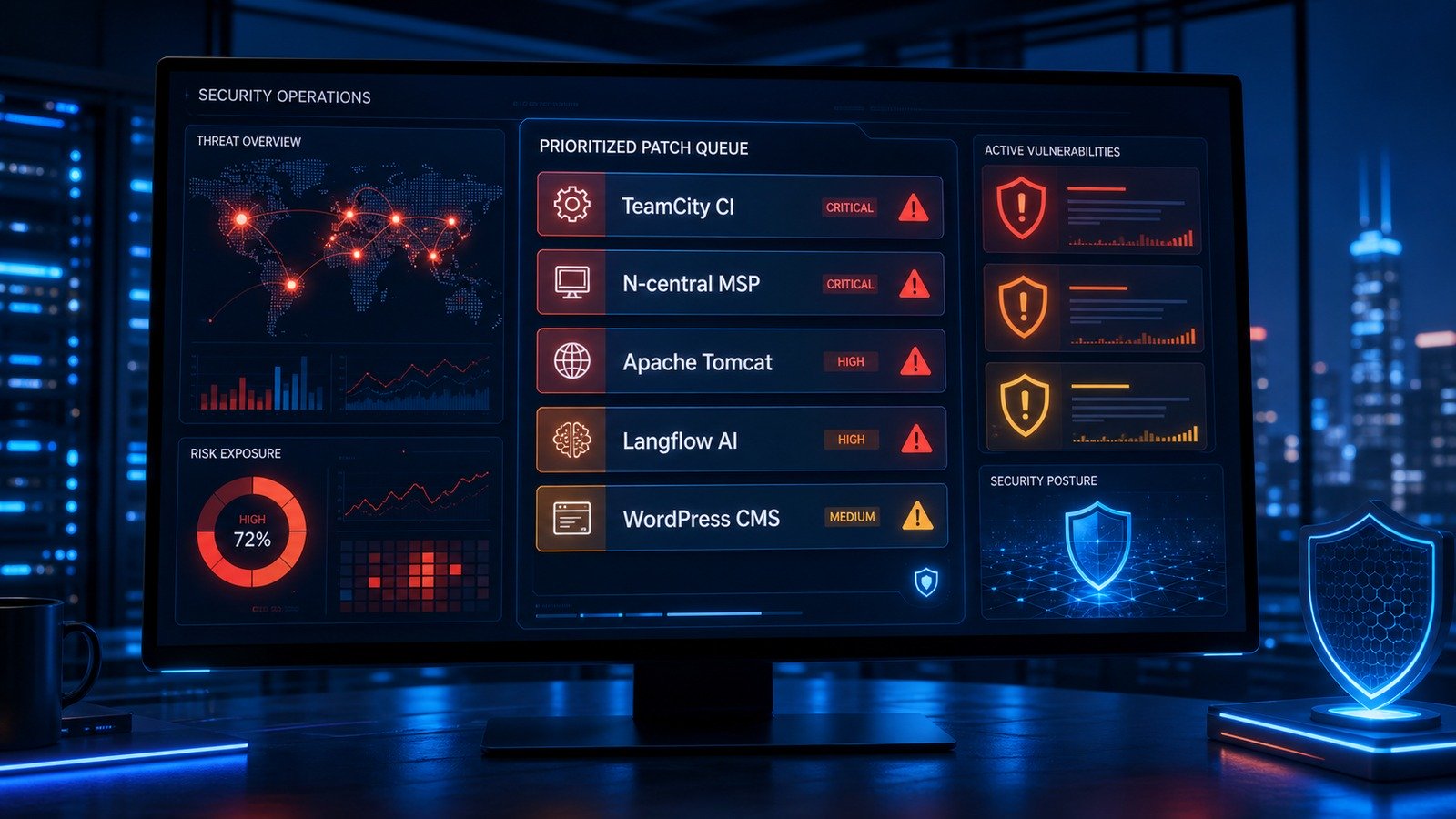
The CISA Known Exploited Vulnerabilities catalog is useful because it answers one question small teams often struggle with: which vulnerabilities are known to be exploited in the real world? The newest catalog version checked for this briefing, 2026.08.06, added several products that can sit close to sensitive systems: JetBrains TeamCity, N-able N-central, Apache Tomcat, IBM Langflow, and WordPress Core.
That mix is important. These are not only endpoint or firewall products. They include build systems, MSP remote management software, application servers, AI workflow software, and website infrastructure. For a small business, the common thread is operational leverage: if one of these systems is compromised, an attacker may gain a path into code, customer environments, internal apps, hosted sites, or automation workflows.
This article translates the latest KEV additions into a small-business patch plan. It is not a replacement for vendor advisories, managed security guidance, or incident response support. It is a practical way to decide what to ask your MSP, developer, hosting provider, or IT owner today.
The short priority list
| Asset type | Latest KEV signal | Small-business action |
|---|---|---|
| CI/CD server | JetBrains TeamCity CVE-2026-63077 | Patch, restrict access, review agents and build credentials. |
| MSP management platform | N-able N-central CVE-2026-18577 and CVE-2026-18556 | Ask your MSP to confirm hotfix status and account-review steps. |
| Java web server | Apache Tomcat CVE-2026-34486 | Identify exposed Tomcat instances and follow Apache guidance. |
| AI workflow app | IBM Langflow CVE-2026-9198 plus recent Langflow KEV history | Remove public exposure, patch, and audit secrets/connectors. |
| CMS / websites | WordPress Core CVE-2026-60137 and CVE-2026-63030 were added in late July | Confirm core auto-updates, plugin/theme updates, backups, and admin MFA. |
1. TeamCity: protect the build system, not just a server
CISA added JetBrains TeamCity CVE-2026-63077 on August 5, 2026. The catalog description says TeamCity contains a deserialization vulnerability that could allow unauthenticated remote code execution via the agent polling protocol. JetBrains also published a TeamCity security issue advisory.
For small software teams, TeamCity is not a random internal app. It often touches source code, build scripts, deployment keys, cloud credentials, package repositories, and release artifacts. If the server is internet-facing or reachable from a vendor network, prioritize it like production infrastructure.
What to do now
- Confirm whether your team, developer, or agency runs TeamCity at all.
- Check whether the TeamCity server or agents are reachable from the public internet or a broad VPN segment.
- Apply the vendor fix or mitigation and verify the exact server version.
- Rotate highly privileged deployment keys if there are signs the server was exposed before patching.
- Review recent builds, agent connections, new users, tokens, plugin changes, and suspicious outbound connections.
If you are still building a basic security program, connect this to CyberTrendLab’s SaaS backup and recovery checklist: build systems should have documented owners, backup/restore expectations, and a clear incident owner.
2. N-able N-central: ask your MSP specific questions
CISA added N-able N-central CVE-2026-18577 on August 3 and CVE-2026-18556 on August 4, 2026. The catalog describes authentication bypass issues, and CVE-2026-18577 is described as an incomplete patch for CVE-2026-18556. N-able published a N-central 2026.3 hotfix mitigation notice.
This matters even if your company does not log into N-central directly. MSP platforms can manage endpoints, remote access, patching, monitoring, and customer environments. A vulnerable management plane can create risk across many downstream businesses.
Questions to send your MSP
- Do you use N-able N-central for our environment?
- If yes, what version and hotfix are currently deployed?
- Was our tenant or any related remote-control activity reviewed after the advisory?
- Are administrator accounts protected with MFA and least privilege?
- Are N-central management interfaces restricted to known networks or protected access paths?
The goal is not to panic or blame the provider. It is to turn a public KEV signal into a clean accountability loop. For broader remote-access design, pair this with CyberTrendLab’s SASE for small business guide and remote browser isolation explainer.
3. Apache Tomcat: do not ignore “internal” application servers
CISA added Apache Tomcat CVE-2026-34486 on August 4, 2026. The catalog describes a missing encryption of sensitive data issue that allows bypass of the EncryptInterceptor and notes that it can be chained with CVE-2025-24813. Apache’s public thread is available through the Apache mailing list archive.
Tomcat is common in older line-of-business systems, vendor portals, internal dashboards, and Java applications that nobody thinks about until renewal or migration time. Small businesses often inherit Tomcat through a vendor, custom app, or legacy hosting environment.
Small-business triage
- Search your hosting inventory for Tomcat, Java app servers, WAR files, and old vendor apps.
- Identify which instances are internet-facing, partner-facing, VPN-only, or fully internal.
- Patch the affected versions according to Apache and vendor guidance.
- Review whether any Tomcat servers expose manager apps, weak admin credentials, or old sample apps.
- Confirm whether the server has access to databases, file shares, or internal APIs that would raise business impact.
For non-technical owners, the practical question is simple: “Do we run any Java web apps, and who is responsible for patching their runtime?” If nobody can answer, the risk is not only this CVE; it is the asset-management gap.
4. Langflow: AI workflow tools need production-grade controls
CISA added IBM Langflow CVE-2026-9198 on August 4, 2026, describing a code injection issue that can allow unauthenticated remote code execution on default Langflow deployments. IBM’s support notice is available at IBM Support. CISA also added a separate Langflow issue, CVE-2026-0770, in July 2026.
This is a useful reminder for AI adoption. Tools that start as quick experiments can end up connected to API keys, databases, shared drives, Slack channels, CRM systems, ticketing platforms, and customer support workflows. If an AI workflow builder becomes internet-facing without authentication, patching, logging, and secret controls, it can become a high-impact application.
Controls to apply before AI workflow tools become real infrastructure
- Keep AI workflow builders private by default. Do not expose them directly to the internet unless there is a documented reason.
- Use strong authentication, MFA where supported, and separate test and production environments.
- Store API keys in a controlled secrets manager rather than pasting long-lived keys into prototypes.
- Limit each connector to the minimum data and actions it needs.
- Log workflow changes, runs, failed authentications, and outbound calls.
- Have a removal plan for abandoned experiments.
This connects directly to CyberTrendLab’s AI vendor risk checklist, least-privilege AI agents guide, and prompt injection examples. AI security is not only model behavior; it is also ordinary application exposure, identity, secrets, and patching.
5. WordPress Core: keep websites in the same risk program
CISA added two WordPress Core vulnerabilities to KEV in late July 2026: CVE-2026-60137 and CVE-2026-63030. If your business website, landing pages, blog, or client portal runs on WordPress, treat core updates, plugin updates, backups, and admin access as part of the same operational security program as laptops and cloud apps.
For small businesses, WordPress risk often comes from process rather than a single headline CVE: abandoned plugins, shared admin accounts, missing backups, stale themes, weak hosting isolation, or no one checking whether auto-updates worked.
Website owner checklist
- Confirm WordPress core is current and automatic security updates are working.
- Remove unused plugins and themes rather than merely deactivating them.
- Enable MFA for administrator accounts where possible.
- Verify backups include the database and uploads, then test restore instructions.
- Review admin users, API/application passwords, and unknown file changes.
- Make sure your host or developer has a same-day patch process for exploited vulnerabilities.
If you rely on WordPress for customer acquisition, a compromise is not just an IT event. It can affect search visibility, lead forms, customer trust, ad account reputation, and email deliverability.
A practical 48-hour patch workflow for small teams
Most small businesses do not need a giant vulnerability-management platform to respond better this week. They need a clear owner, a short list of exposed systems, and proof that the riskiest assets were checked.
Hour 0-4: assign ownership
- Name one person responsible for the KEV review.
- Send the MSP/vendor questions above if any managed platforms are involved.
- Pull a quick inventory of developer tools, CMS platforms, Java servers, AI workflow tools, and remote management systems.
Hour 4-24: sort by exposure
- Put internet-facing systems first.
- Then prioritize systems with admin access, secrets, customer data, deployment keys, remote-control capability, or internal network reach.
- Do not let low-visibility systems hide behind the phrase “internal only” until someone verifies segmentation.
Hour 24-48: patch, restrict, and review
- Apply vendor fixes or mitigations.
- Restrict management interfaces to VPN, Zero Trust access, or known admin networks.
- Review logs for suspicious login, agent, connector, plugin, or build activity.
- Document what was fixed, what still needs a vendor response, and what compensating controls are in place.
What to prioritize if you cannot patch everything today
If your inventory is messy, use this order:
- Known exploited and internet-facing: anything listed in KEV that is exposed to the public internet.
- Management-plane systems: MSP consoles, firewalls, CI/CD, identity, remote access, backup consoles, and RMM tools.
- Systems with secrets: tools that store cloud tokens, deployment keys, API keys, database credentials, or customer data.
- Widely used public platforms: WordPress sites, web servers, and public application stacks.
- Experimental AI tools: anything launched quickly with broad connector permissions or weak authentication.
That order is not perfect, but it is better than sorting by severity score alone. CISA’s KEV signal tells you exploitation is real. Your business context tells you which compromised system would hurt most.
FAQ
Do small businesses need to follow CISA KEV if they are not federal agencies?
Federal deadlines apply to federal civilian agencies, but the catalog is still useful for everyone because it identifies vulnerabilities with known exploitation. Small businesses can use it as a practical risk signal.
Should I patch these even if my system is behind Cloudflare or a VPN?
Yes, but exposure affects urgency. If a vulnerable admin interface is truly private and strongly access-controlled, it may rank below a public vulnerable service. Do not assume it is private until someone verifies routing, firewall rules, identity controls, and logs.
What if my MSP says they handle all of this?
Ask for a short confirmation: whether affected platforms are in use, what version or hotfix is deployed, whether customer environments were reviewed, and whether any follow-up actions are needed from your side.
Is this only about patching?
No. Patching is the first step. Management consoles, CI systems, AI workflow tools, and CMS platforms also need restricted access, MFA, least privilege, logging, backup coverage, and clear ownership.
Final takeaway
The August 2026 KEV additions are a reminder that small-business security is now a stack problem. Your risk may sit in the MSP tool, the CI server, the Java app nobody remembers, the AI workflow prototype, or the WordPress site that drives leads. Use CISA KEV as the trigger, but make the decision based on exposure and business impact.
For a broader baseline, read CyberTrendLab’s small business security stack, ransomware prevention checklist, and phishing prevention checklist. Those controls make every future KEV event easier to handle.